July 2026
Project Poëtica / Bridwell Press
Order from
Bridwell Press
Bookshop.org
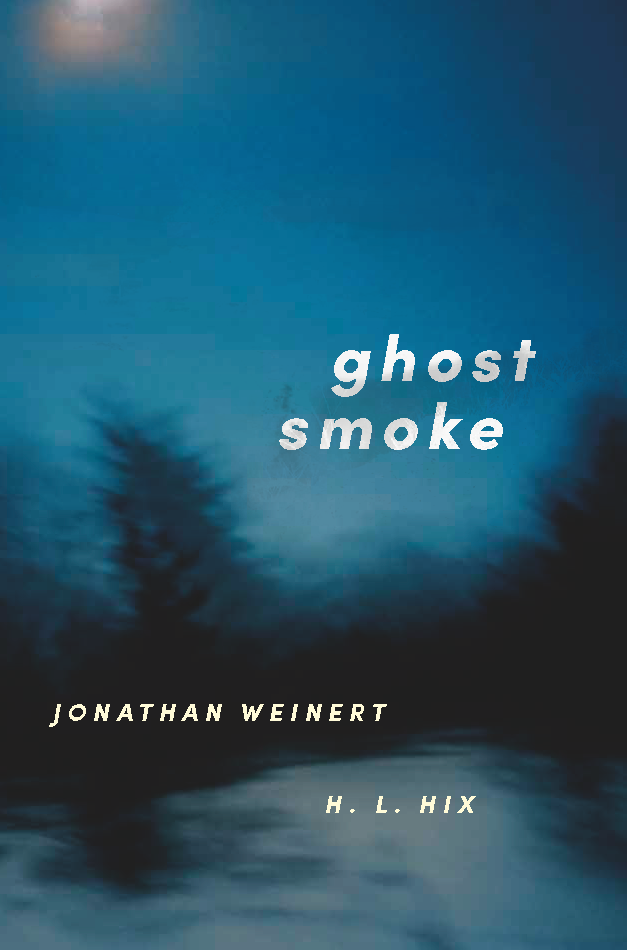
A book-length hybrid poem in collaboration with H. L. Hix
“Every atom belonging to me as good belongs to you,” wrote Walt Whitman. Poets H. L. Hix and Jonathan Weinert adopted Whitman’s declaration as a guiding principle for Ghost Smoke. In this “Song of Themself,” Hix and Weinert merge their voices to create a spirited book-length hybrid poem that meditates on distance, listening, finitude, and different kinds of love. Fabricated of material collected from over two decades of correspondence and collaboration, Ghost Smoke borrows the structure of a crown of sonnets, completing a circuit that seeks to defeat the standard distinctions between question and answer, presence and absence, self and other. Is it possible to find a language that can allow us to become more porous to one another, to listen more deeply to one another and to respond in kind? Can we become each other’s ghosts, open to and inhabited by one another? What happens to us, and what happens between us, if we do? Ghost Smoke poses and explores these questions, and invites other voices, including the reader’s, to engage in the conversation.
What is “the music of hinges”? Does it take its place between two authors who
become, in part, the authors of each other? Or between readers and whatever
readers start reading? Does it stop when we stop? Does it pull out all the stops?
What are its “gauzy residuals,” and might they be mirrors, as well as smoky
windows? How do its geographically drifting afterimages come to seem to see us? These two poets borrow from one another so intensely that they become a third, no, a fourth, no, a perfect fifth: their language, in broken-up semi-paragraphs of meteorological genealogy (like Forrest Gander’s geologies), in iterative musings,
in its “water cortège,” becomes leaves of meditation as various as the botanies
that it also observes, “heart-shaped and serrate,” “an envelope inside a fire,” a
yearning, a “mishap on Mrs. Foote’s spinet” become a sharable epiphany. Spend
time with this whole book. Get lost in it. You’ll find your way into the clouds. Or
your way home.
— Stephanie Burt, author of
We Are Mermaids
Writing together, in one voice, the dazzlingly inventive Jonathan Weinert and H. L. Hix are more than a duet; the two poet-friends (individually sublime writers) are a blend, like a luxurious tweed, or a spirited whiskey, or a vigorous hybrid tree.
With Ghost Smoke we’re in their poetry laboratory, where they mix the everyday
with searching philosophy. Unafraid to explore feelings, think-y, but gossipy and
loving, Weinert and Hix are relaxed aerialists, one flying, the other catching, yet both in the air at once. Ghost Smoke is a beautiful and brilliant book.
— Molly Peacock, author of
A Friend Sails in on a Poem
The image of two relay runners during the precarious baton handoff came to me,
reading Ghost Smoke. No individual effort matters if this handoff fails. Hence,
there is tension which is always good for poetry—and especially in this book.
I felt the stride-by-stride calibration, an intense listening, a synchronization,
language touched by both, shuttled between. Then some wildness borne of
this shuttling would take off and return again to the tense exchange. What
these generous two-as-one poets make is a book as curriculum: an encircling,
coming around again and again, like circling Jericho to bring the faulty walls of
individuation down. I’m now thinking, we are all collaborating all the time, as we
write and read—and so I thank Hix and Weinert for this project to teach us how
to recalibrate authorship back to human which is never one.
— Jill Magi, author of My Penelope
“There is no poem of one’s own,” write Hix-Weinert or Weinert-Hix, this writingreading phenomenon that is no longer two and is much more than one. A
collaboration that spans twenty years of an intimacy born and buoyed by writing, Ghost Smoke is a voice, a “single sounding-through” drawing us directly
into its expansive, and gorgeous, soundscape. Their deep phenomenological attunement to the particulars of land, weather, and time—“a cottonwood leaf tracked in wet and flat but now curled dry,” “Light snow overnight omened the afternoon eclipse”—calls us too to attend. “You should see the squirrels and sparrows here / moonscaping with their dustbaths,” they say. I am convinced
by the delicate and pulsing beauty of this writing that we can only hear “the
nameless that exceeds us” together.
— Julie Carr, author of The Garden and,
with Lisa Olstein, Climate